Understand the main match loop
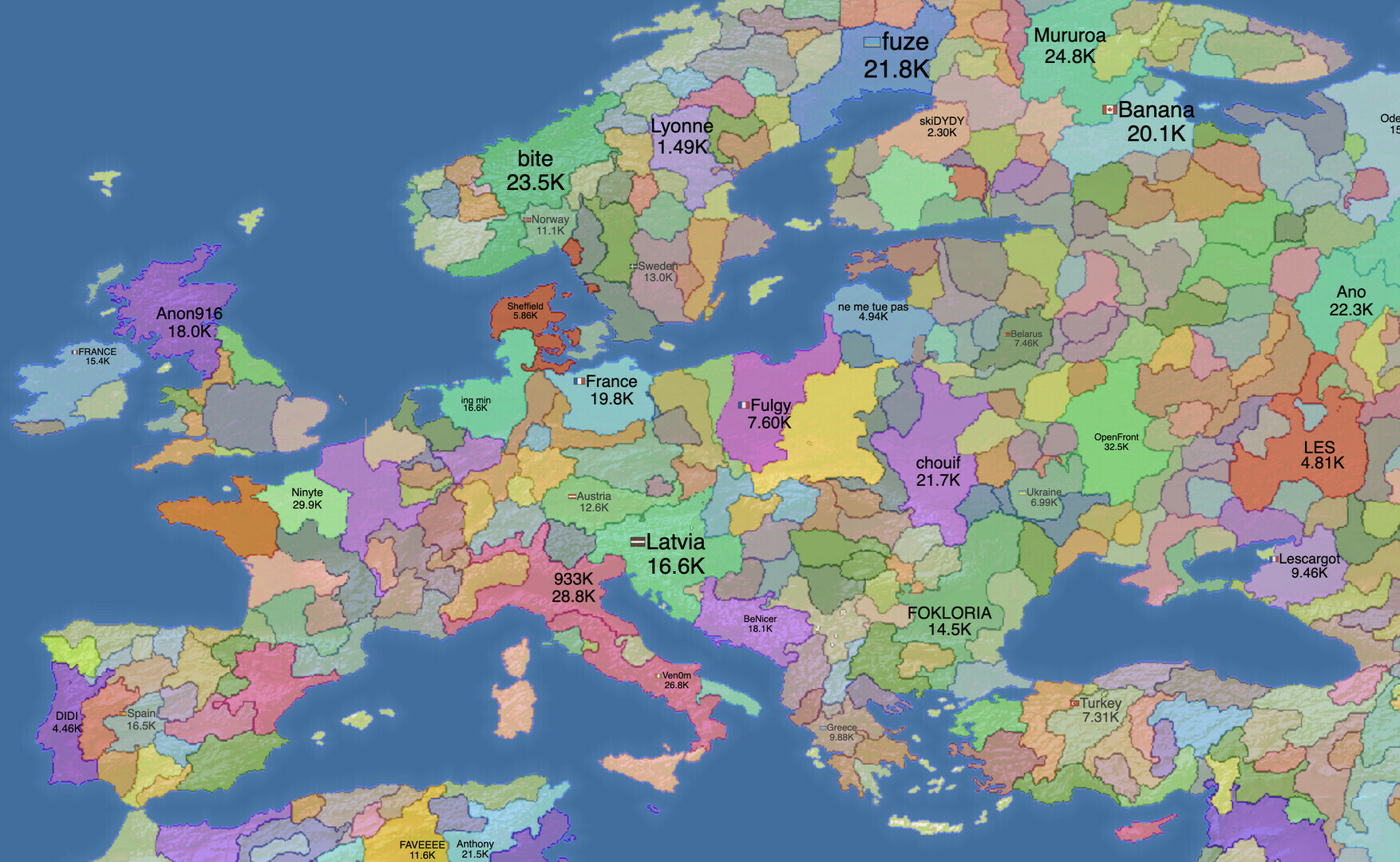
Claim tiles, grow an army, spend Gold on structures, and turn enough living land into victory. OpenFront is a real-time map war played in the browser.
The attack ratio controls what percentage of your current troops a click sends. T lowers it, Y raises it, and Shift plus the mouse wheel also adjusts it; advantages beyond roughly 2:1 provide diminishing loss reduction and do not justify sending everything.
Balance the shared population pool between troops that fight and occupy and workers that support the economy. A high troop share can slow Gold on a quiet map, while a low share can leave a contested border exposed.
Troop growth peaks near 42% of capacity. Wait after a large send, and use a City when repeated contact with the cap is restricting further growth; every City level adds 250,000 capacity.
Ordinary victory requires about 80% of non-fallout land, with water excluded. Fallout changes the usable pool, and free-for-all Overtime can lower the required share in steps after minute 30.
First-match route to a stable position
- Choose a public free-for-all or a quiet single-player match against Bots. Keep the opening focused on spawn quality, steady growth, and reaching your first City and Port.
- Click a spawn quickly after the map appears. Favor a pocket with plains, useful coast, and few exposed approaches; a peninsula with one land neck is safer than open plains bordered by four neighbors.
- Use plains for the first annex and keep mountains out of your initial route. Highlands are workable behind plains, while mountains are expensive to capture and hold.
- Left-click unowned land or Bot territory and send roughly 20–40% in the opening. Leave a reserve on home tiles instead of committing 80% and stalling growth after the first target.
- Target Bots first: they are weak, do not build, and provide land and Gold when surrounded and finished. Nations place buildings and can use nukes later, while human players are the immediate strategic threat.
- Finish a surrounded Bot before creating a long Nation border. Treat a Nation with a City as a later target rather than part of the opening.
- If another player starts surrounding the same Bot, stop contesting it and turn toward empty plains or a different Bot. Accepting a pact with a stronger neighbor can let you continue expanding on the opposite side.
- Buy the first City once you have 125,000 Gold. It takes about 20 ticks to build and adds 250,000 troop capacity, helping you continue expansion without sitting near the top of a small cap.
- Buy the first Port after the City when the coast is useful. It starts at 125,000, while Ports and Factories share a cost sequence of 125,000, 250,000, 500,000, and then 1,000,000; wait on a Factory until a City or Port is within about 110 tiles.
- When a human border appears, lower the attack ratio and stop using the Bot-opening pace. Keep taking empty plains when appropriate, but do not send half the army into a mountain protected by a Defense Post.
- Place a Defense Post on the neck that is actually threatened. The first costs 50,000, covers about 30 tiles, is destroyed rather than transferred when captured, and can be placed with number key 4.
- Read terrain before attacking: plains use the community figures mag 80 and speed 16.5, highlands use mag 100 and speed 20, and mountains use mag 120 and speed 25. Higher mag means more attacker losses, while higher speed in this formula means a slower advance.
- Account for fortification multipliers. A Defense Post within 30 tiles multiplies terrain mag by 5 and speed by 3, making a mountain post the hardest listed combination and a plains post a cheaper but still substantial wall.
- Treat an alliance as temporary. Its default duration is about 3000 ticks, or roughly five minutes, and mutual consent can renew it; wait for a clean expiry before attacking when possible.
- Breaking an alliance applies the traitor state: defense is multiplied by 0.5 for about 300 ticks, or roughly 30 seconds, speed receives a community-listed 0.8 multiplier, trade pauses under an embargo, and other players can see the broken-shield mark.
- In an ordinary endgame, pursue non-fallout land rather than water and watch the live interface if Overtime begins lowering the victory threshold after minute 30.
- In Doomsday Clock, expand before the first wave. After a 10-minute grace period, the free-for-all land-share ladder rises through 2%, 4%, 7%, 11%, 17%, 25%, and 35%; sides below the live threshold receive a warning before troops and warships drain with a floor.
- Doomsday Clock is a rising usable-land-share test rather than a shrinking circle. Water does not satisfy the test, and team modes use a higher threshold ladder.